 bug.lat
Skyrim, generated.
Skyrim Creation Kit MCP Server
A Model Context Protocol server and a .NET build pipeline that let AI models build Skyrim Special Edition worlds: mountains, rivers, waterfalls, biomes, forts and towns, roads and bridges, caves and ruins. The aim is a world that looks like Bethesda made it and works in the game.
Every picture below is a real build output, shown next to vanilla Skyrim wherever a comparison exists.
80
MCP tools an AI client can call
8
landscape scene types, each modeled on a real part of Skyrim
11–25 s
to generate a 64×64-cell world’s terrain, rivers and lakes
272
Bethesda sites in the transplant library, 263 passing headless checks
0
differences along the seams of three regions built separately and joined
550
commits in the first seven days, each result rebuilt and checked from its commit
Landscape
Terrain made from Skyrim itself.
The first generator drew mountains from math, and they never looked like Skyrim. The current one plans the large shape, then builds the ground out of real pieces of Bethesda’s landscape.
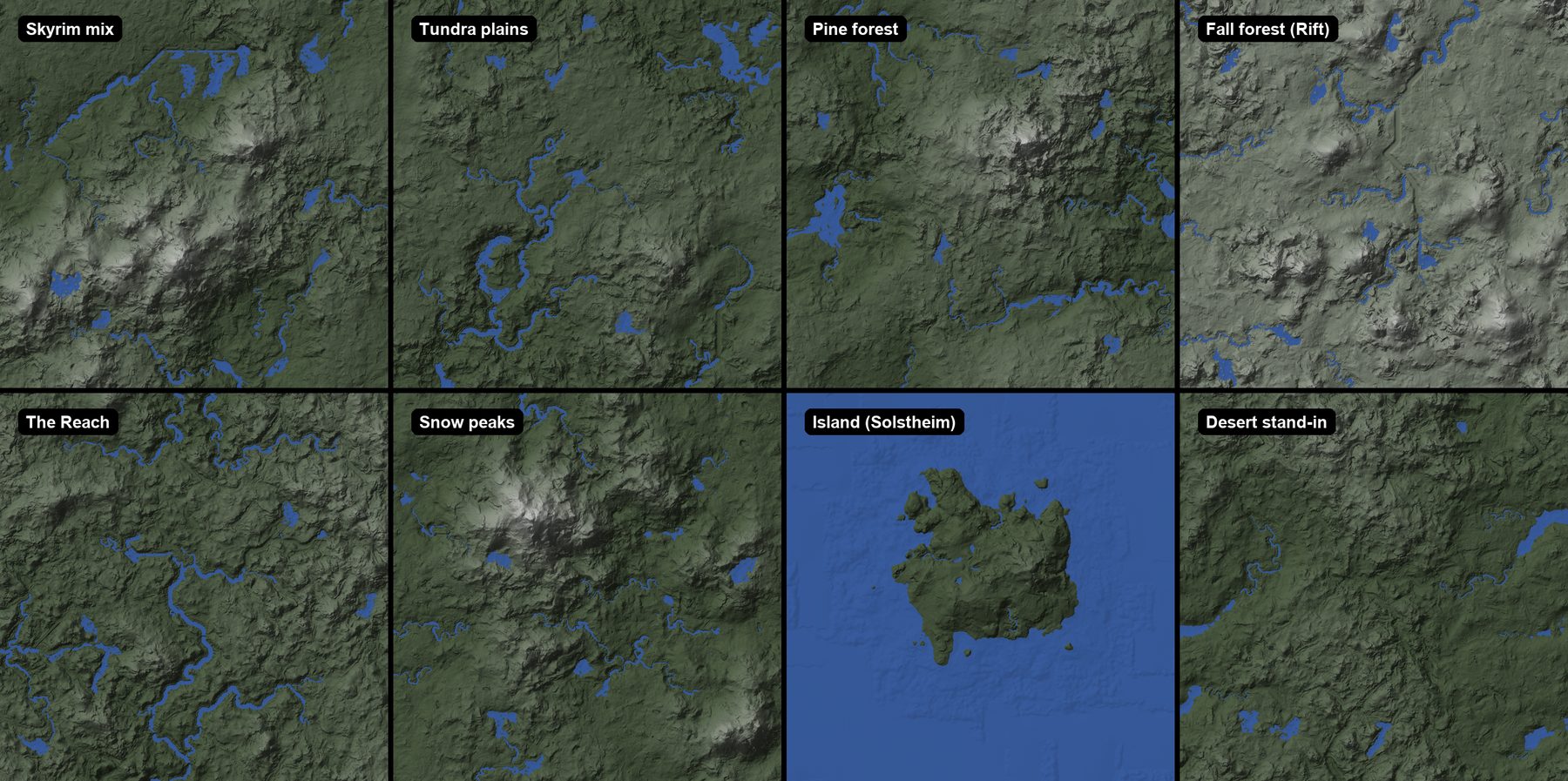
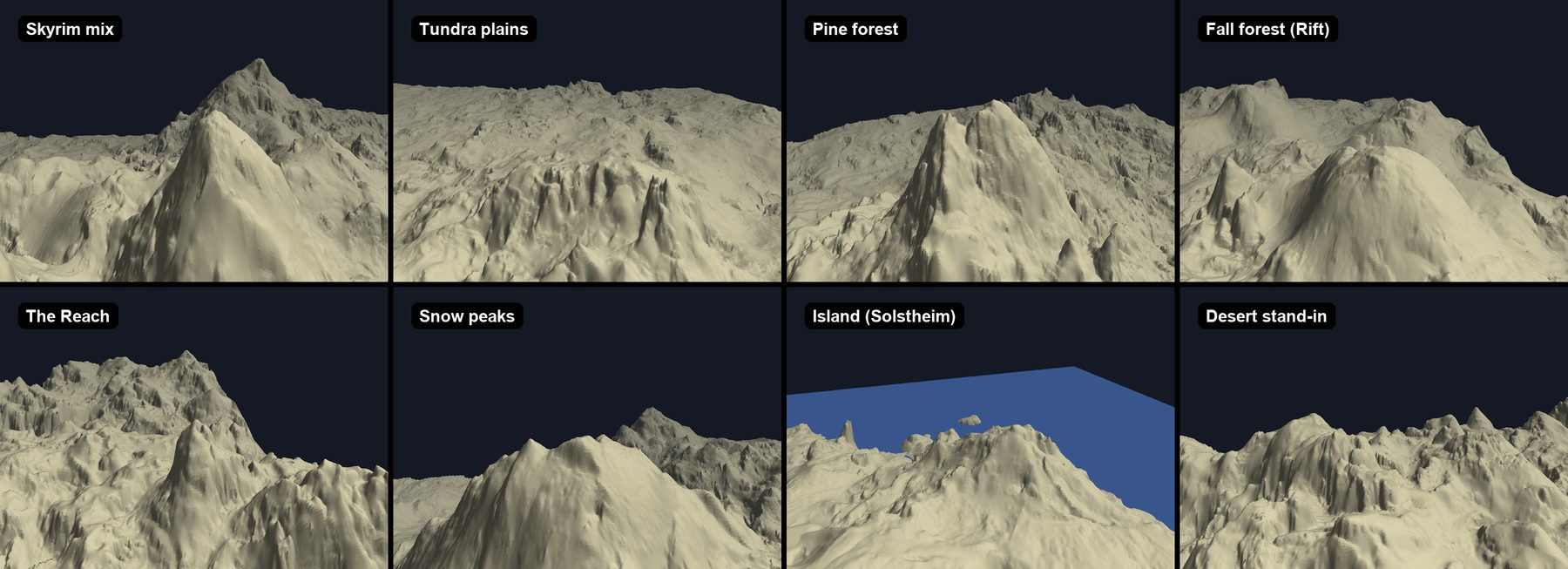
Scene plan first. A seeded plan lays out where the ranges, basins, valleys and coast go, using proportions measured from a real part of Skyrim for that scene type. A pine scene gets the Falkreath forest hills; a Reach scene gets the Reach’s broken rock; an island scene gets a Solstheim-like coast.
Then quilting. The ground inside the plan is assembled from 5×5-cell pieces of Tamriel and Solstheim. Each piece is chosen to match the plan and its neighbours, then blended in. The Throat of the World is left out of the library so it can’t be copied, and no generated peak rises above its height.
Then water. Rivers are carved downhill to lakes or the sea with a continuous bed, lakes get stepped water planes like vanilla’s, and waterfalls form where a river drops between levels.
Deterministic. The same seed, settings and game files always give the same terrain, byte for byte. A scene builds in 11–25 seconds for 64×64 cells on a 32-thread machine.
| Scene | Terrain pieces from | Character |
|---|---|---|
| Skyrim mix | All of Skyrim | Ranges, open tundra, river valleys, lakes |
| Tundra plains | Skyrim’s tundra region (Whiterun’s plains) | Wide, gentle ground with meandering rivers |
| Pine forest | Skyrim’s pine forest region (Falkreath) | Rolling hills, many small lakes |
| Fall forest | Skyrim’s fall forest region (the Rift) | Lumpy ground, terraces, many lakes |
| The Reach | The Reach | Broken rock, gorges, steep small hills |
| Snow peaks | Skyrim’s snow region | Tall single massifs and high valleys |
| Island | Solstheim | Coastline, offshore islets, a central upland |
| Desert (stand-in) | Reach badlands, Eastmarch volcanic flats, Solstheim ash | Dry, rugged ground with few rivers |
Water
Rivers, lakes and waterfalls.
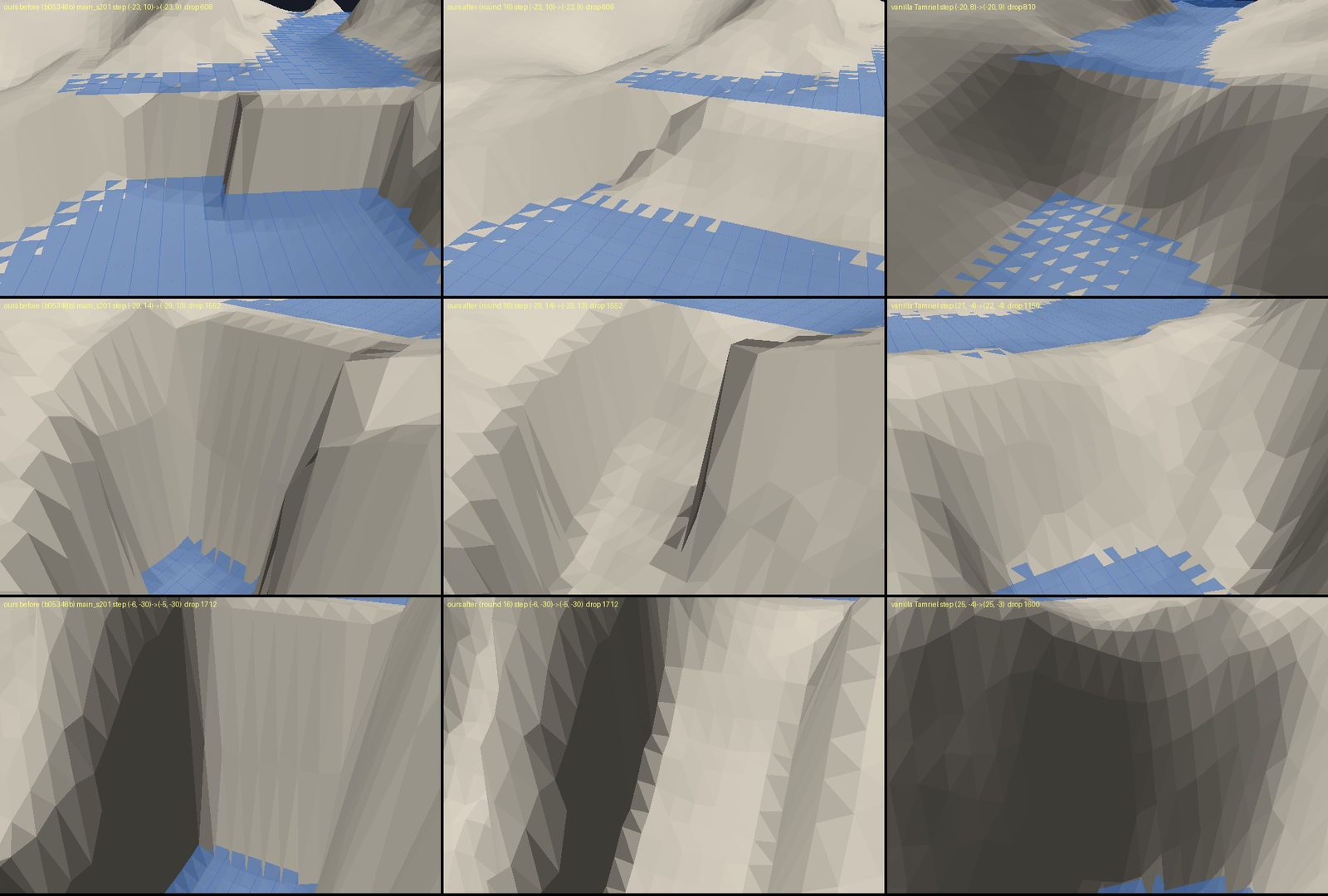
Skyrim’s rivers step down through the landscape on flat water planes, with a waterfall at each step. The generator reproduces that, and every river is checked from source to mouth.
| Measure (median) | Before | Now | Vanilla |
|---|---|---|---|
| Lip height, share of the drop | 0.94 | 0.65 | 0.63 |
| Biggest single step on the face (units) | 672 | 200 | 164 |
| Face steepness | 75° | 39° | 27° |
| Face area steeper than 45° | 59% | 35% | 31% |
| Plunge pool depth (units) | 168 | 200 | 169 |
The faces are still a little steeper than vanilla’s, mostly because our falls drop further (a median of 1,104 units against vanilla’s 762). Every build checks that rivers carry water along their whole length (at most 0.1% of river points dry), have no breaks, and don’t kink at cell edges. On today’s 24 test worlds all water checks pass.
Biomes
Biomes from the land, not the map.
Which ground textures, trees and rocks go where is now decided by the scene type and the shape of the land, the way Skyrim’s own regions follow its terrain.
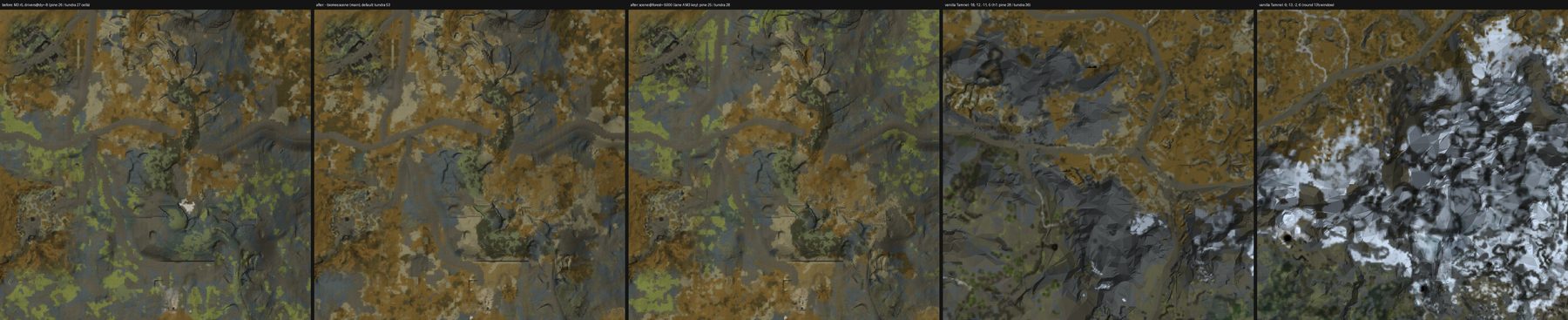
How it works. Each scene type carries vanilla’s mix of biomes for that kind of country. A model trained on Tamriel then places them by elevation, slope and terrain shape. Map position is never an input, so no border runs straight across the world. An optional forest-line setting moves the pine/tundra boundary up or down the hills.
Results. In the test region the longest straight run of biome border fell from 17 km to 12 km (vanilla areas: 14–34 km). Transitions are as wide as vanilla’s, about 1,300 units. There are no volcanic patches where they don’t belong.
Filling. Trees, shrubs, rocks and ground cover come from terrain-matched patches of vanilla Skyrim, at vanilla’s density. The forest floor follows the trees, roadsides get their own trees, and a regulator keeps exposed rock near vanilla’s share. Still open: shore textures appear beside some inland lakes, and the default Skyrim mix makes too little fall forest (1% against vanilla’s 7.6%).
The test region
Milestone 3: a whole region.
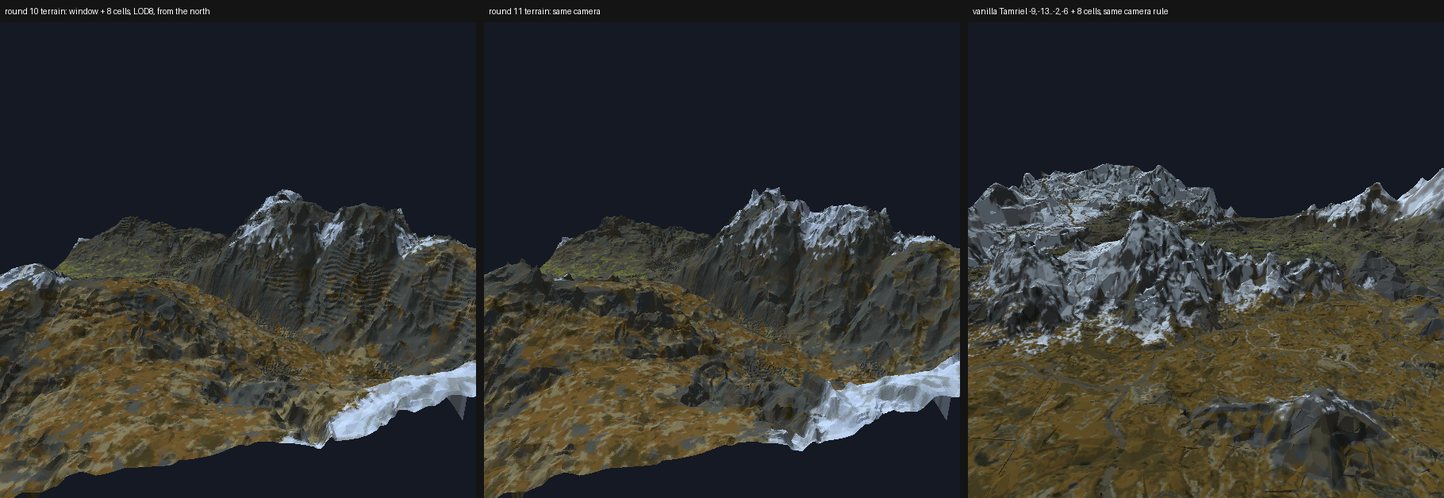
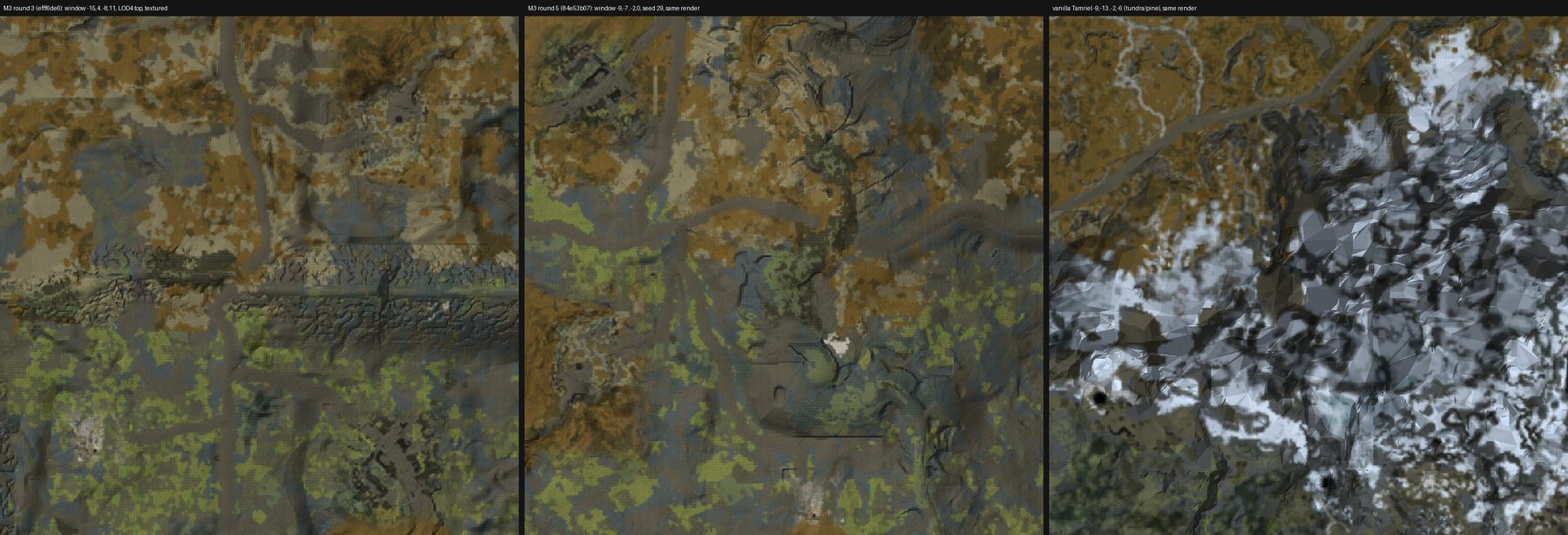
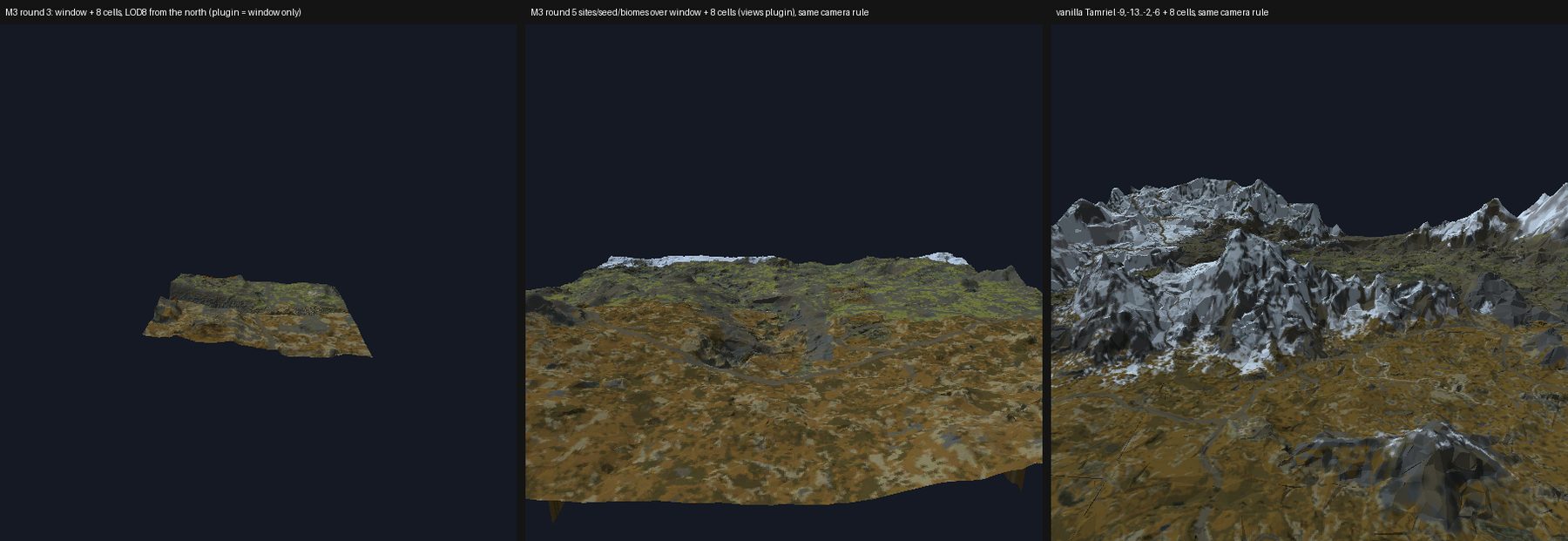
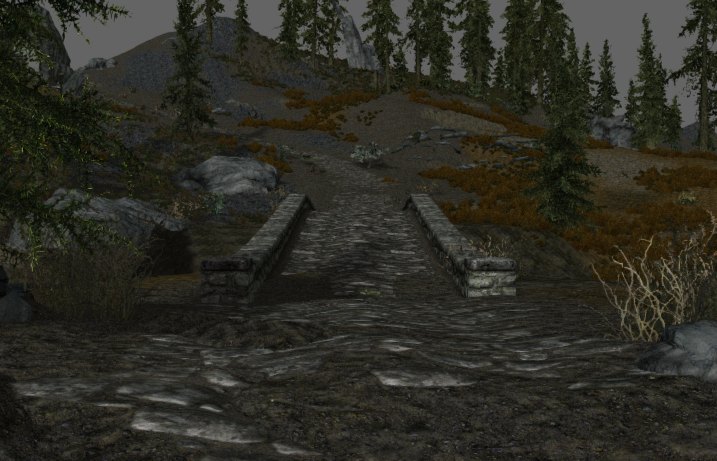
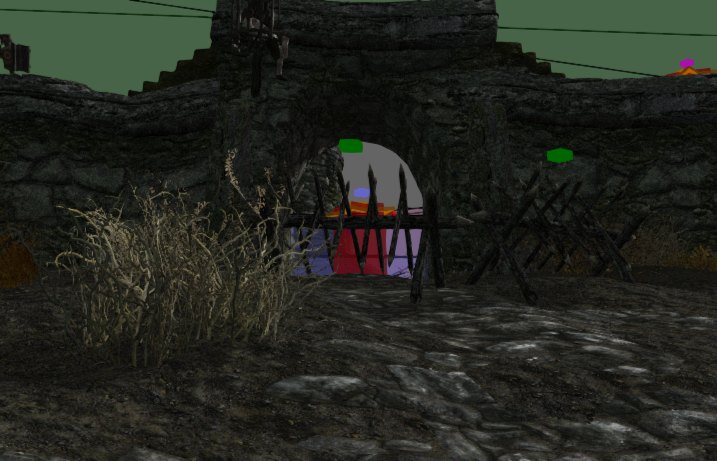
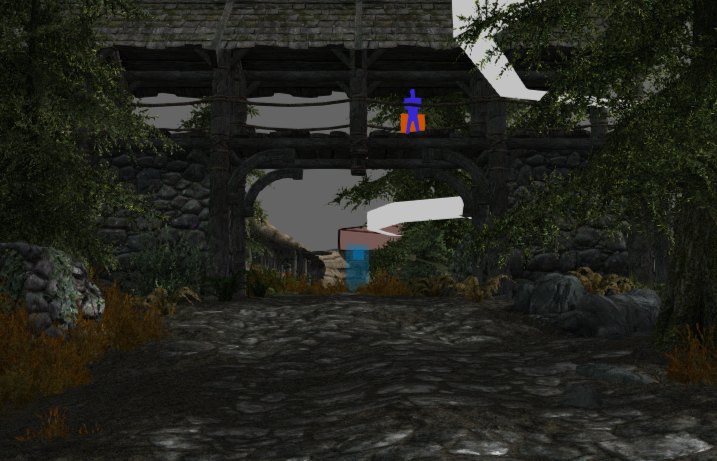
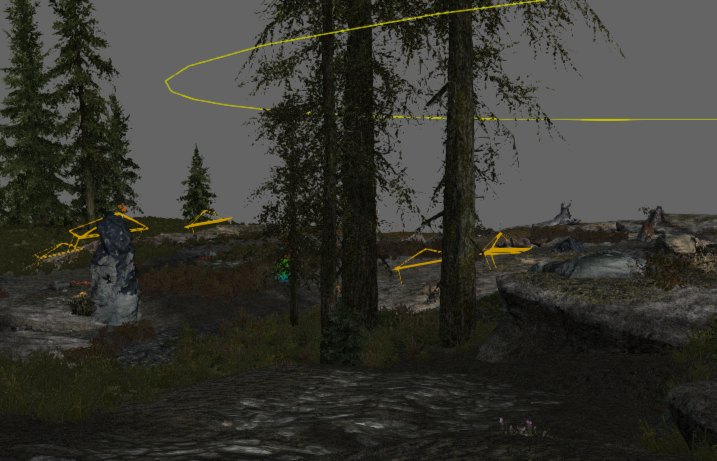
An 8×8-cell region written by one command: generated terrain and river, three transplanted sites, a highway with a vanilla bridge, biome fill, navmesh, gameplay records, and distant LOD.
| Round 5 check | Result |
|---|---|
| Rebuilt from its commit on a clean copy | Byte-identical (raw and final plugin hashes match) |
| Plugin read back with Mutagen | Pass |
| Walkability routes on the navmesh, bridge deck included | 7 of 7 |
| Roads crossing water without a bridge | 0 |
| Site and road banks steeper than vanilla’s | 0 |
| Distant LOD generated unattended | Yes |
Round 6 (building now) rebuilds the same region on the new biomes, blends each transplanted site’s vanilla ground into the surrounding biome (Fort Dunstad’s snowy square was the visible case), and makes sites near a tile edge reproducible from both sides.
Scale
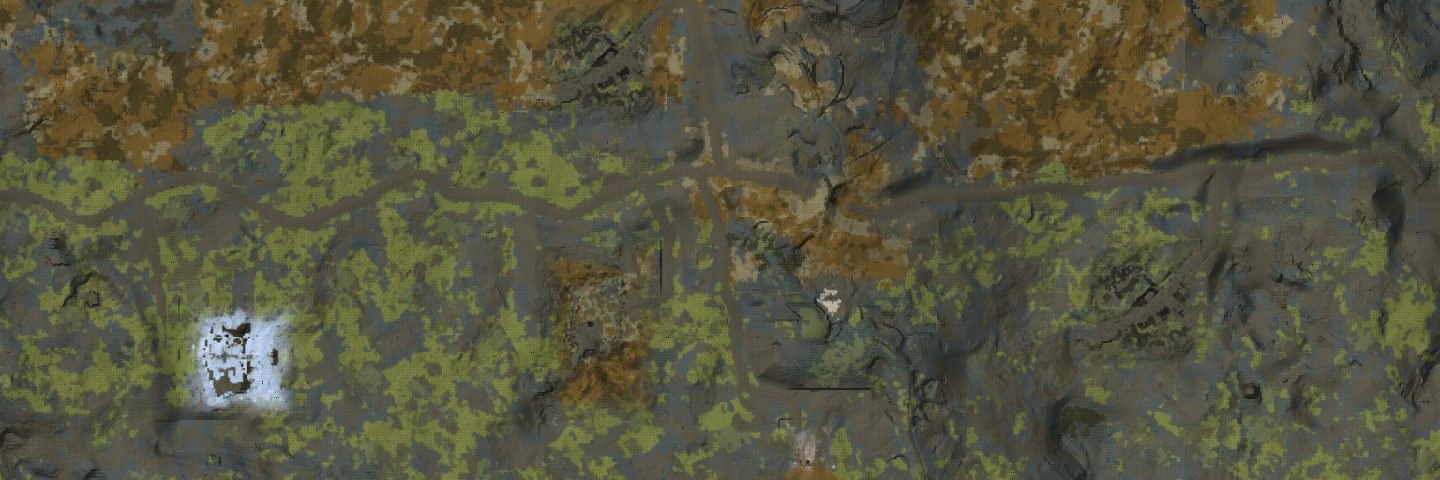
Regions that join without seams.
A full world will be built tile by tile, so separately built regions have to meet exactly.
Sites
Learning from Bethesda’s sites.
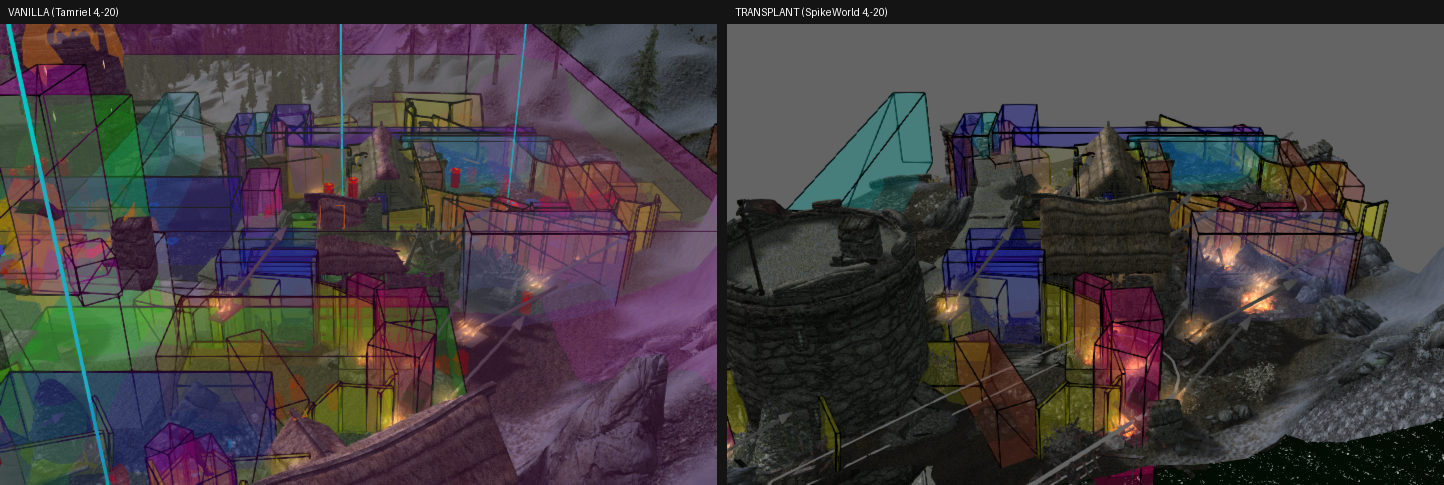
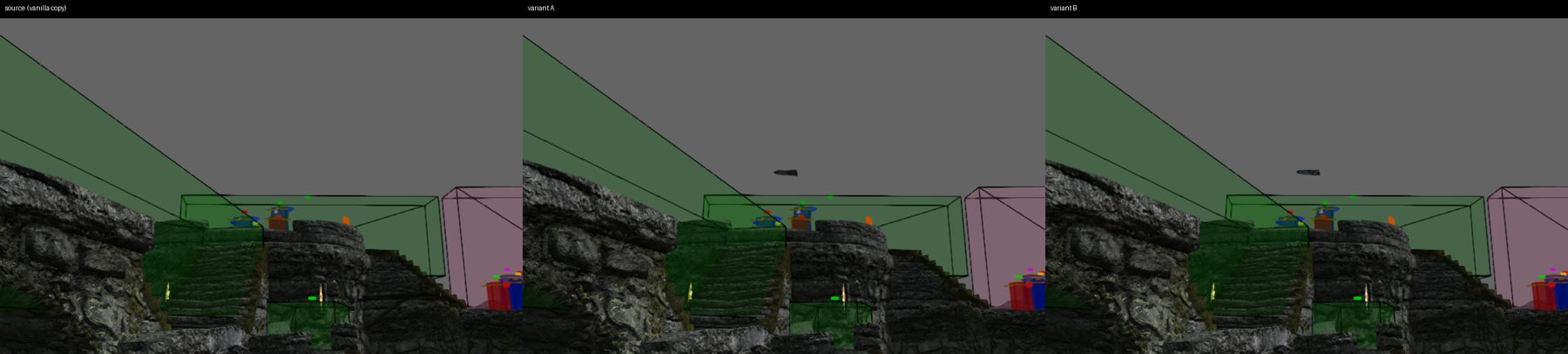
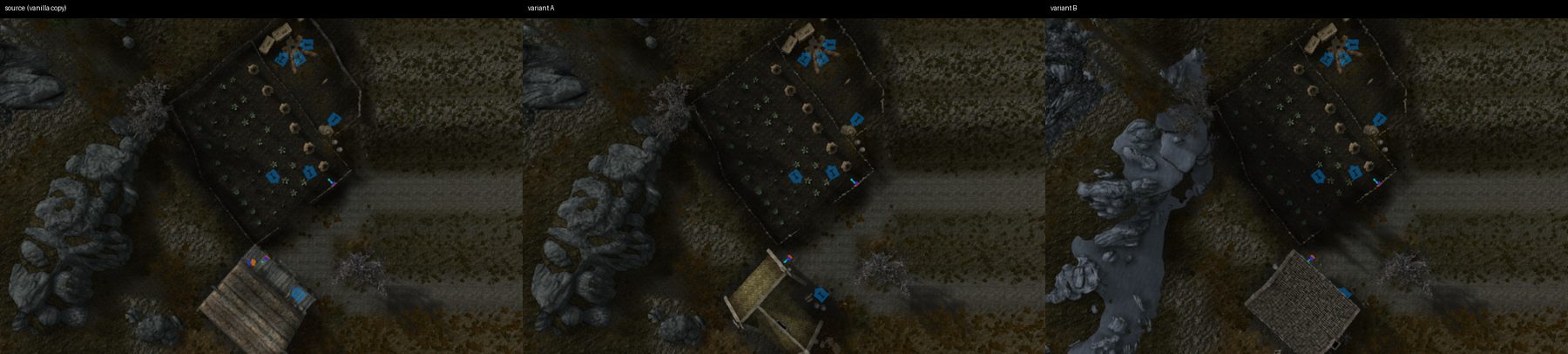
Procedural towns look procedural. So the engine starts from complete Bethesda-authored locations and climbs a ladder of variation, learning the rules from the game itself.
Highlighted rungs work today. 1,398 snap rules have been learned from Bethesda’s kit pieces.
Where sites go
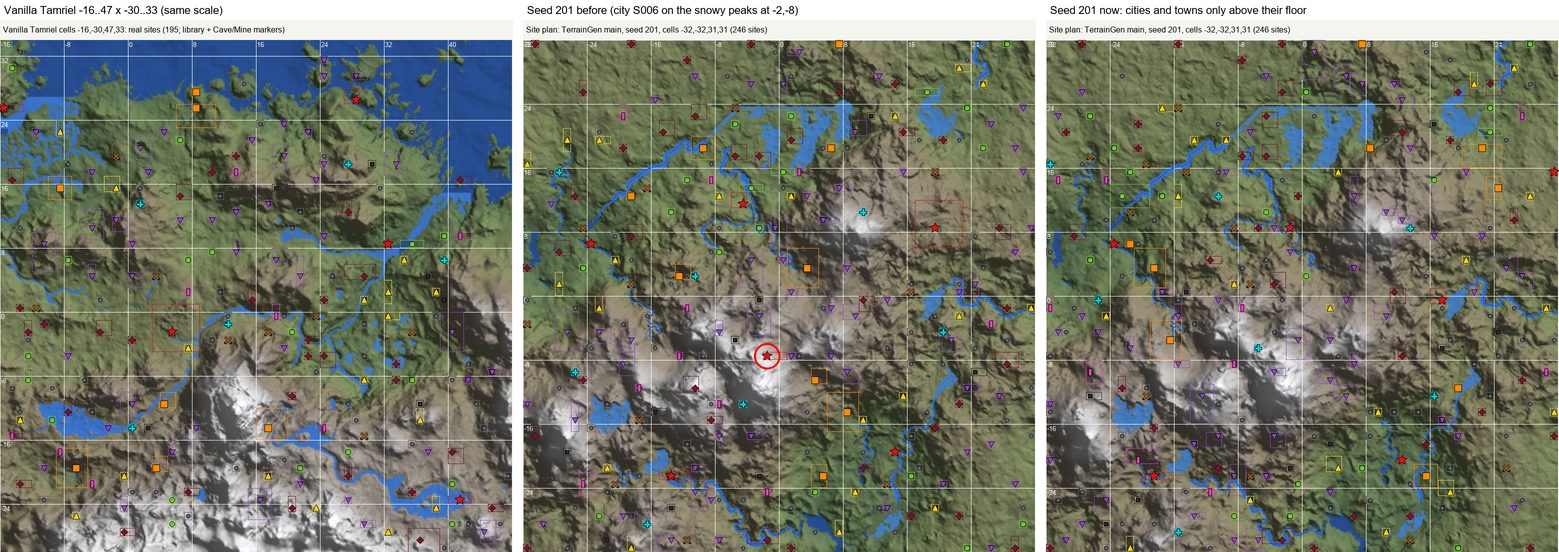
A deterministic planner places cities, towns, villages, forts, farms, mines, camps, ruins, towers and shrines across a generated world, using spacing and ground rules learned from 279 Tamriel sites. A 64×64-cell world gets about 246 sites. The current revision only places a city where the ground is as good as vanilla’s city sites, preferring fewer cities to bad ones.
Roads
A road network learned from Skyrim’s.
Skyrim’s road network was measured from its road pieces and path textures: 78 km of road and 38 bridges. The planner reproduces how those roads choose their routes.
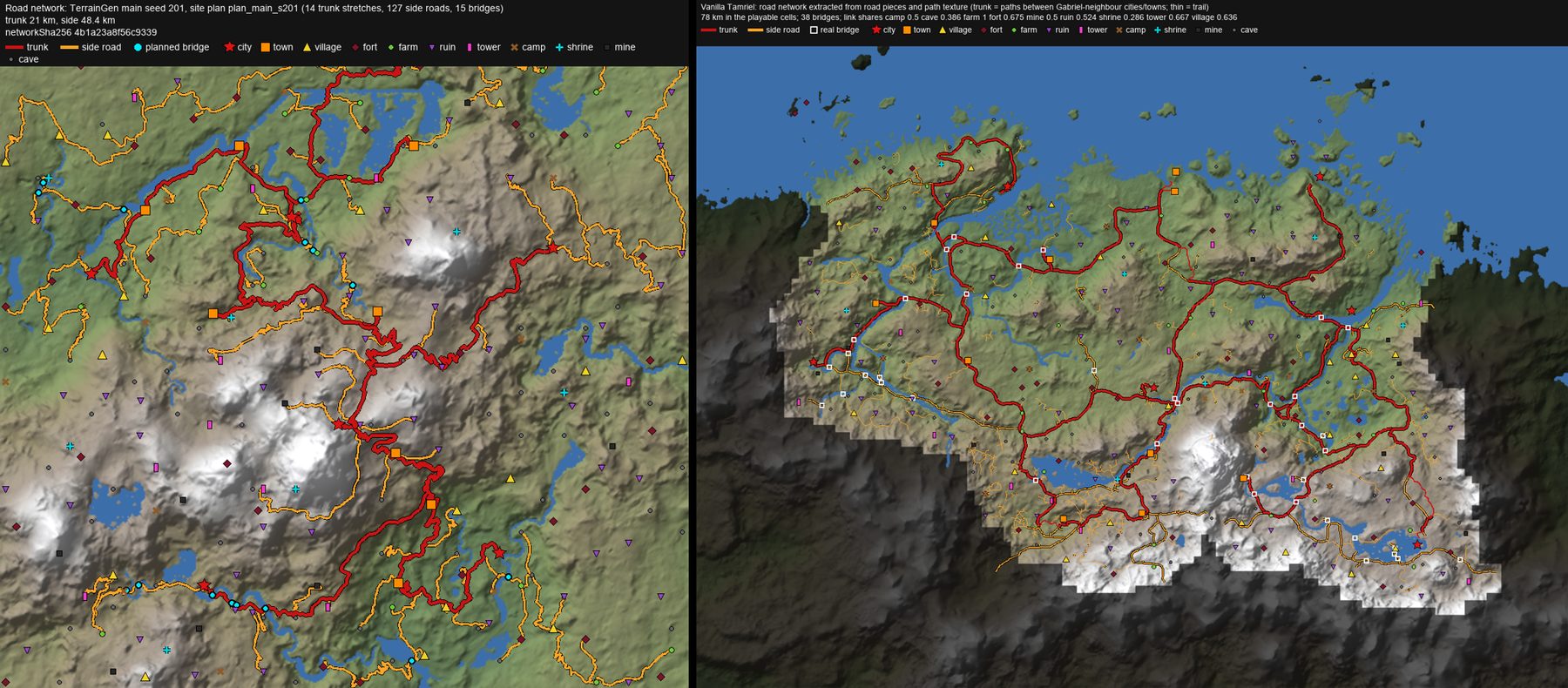
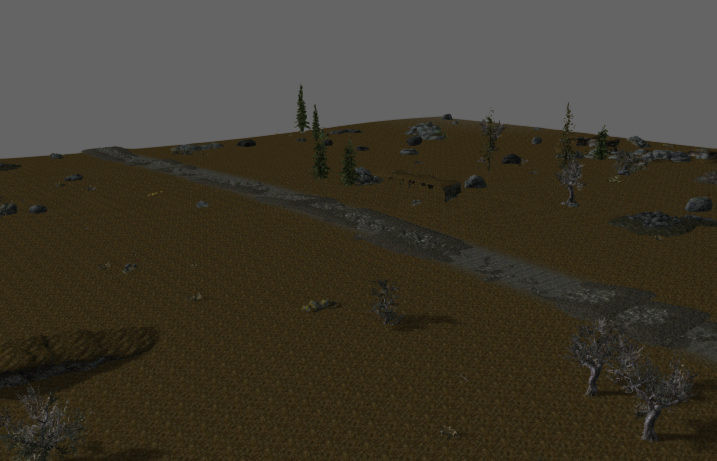
Calibrated on real roads. A least-cost router was tuned so that, between real Skyrim sites, 29% of its route lies on vanilla’s actual road, against 15% for a shortest-path baseline. Roads are then assembled from vanilla road pieces with blended shoulders. A build gate refuses any road that crosses water without a bridge.
In progress: fords where vanilla would use them (about 40% of vanilla’s river crossings) and smoother hairpins on steep ground.
Interiors
Caves and Nordic ruins from Bethesda’s kits.
The dungeon generator snaps Bethesda’s own kit pieces together using rules learned from vanilla dungeons, then adds navmesh, doors and lighting.
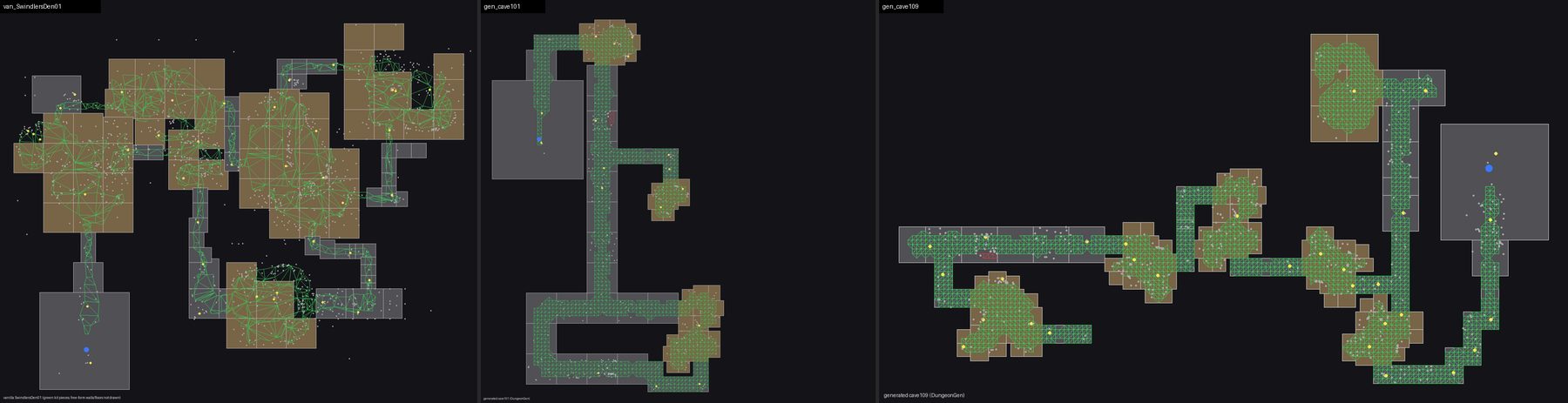
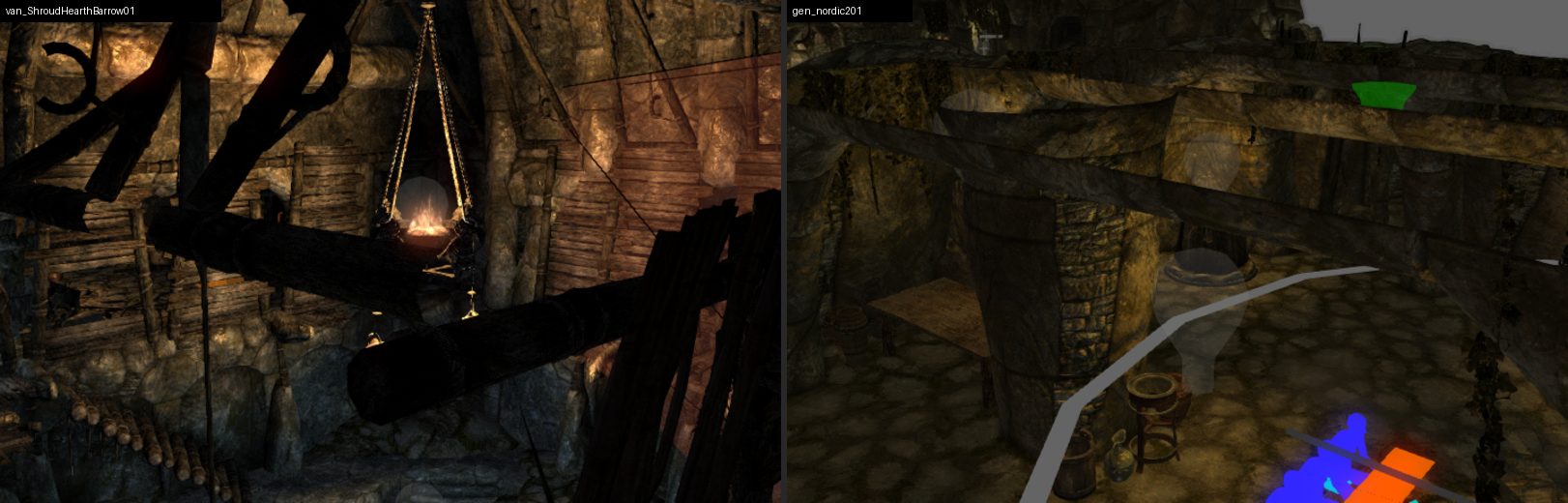
Each generated dungeon is read back, checked for gaps between pieces, and its navmesh tested for reachability, and it rebuilds identically from its commit. Generated navmesh was about four times denser than vanilla’s; round 3 thins it to vanilla’s density. The first linked interior, the Guldun Rock cave behind Fort Greymoor’s sewer grate, was approved.
New biomes
Ready for new lands.
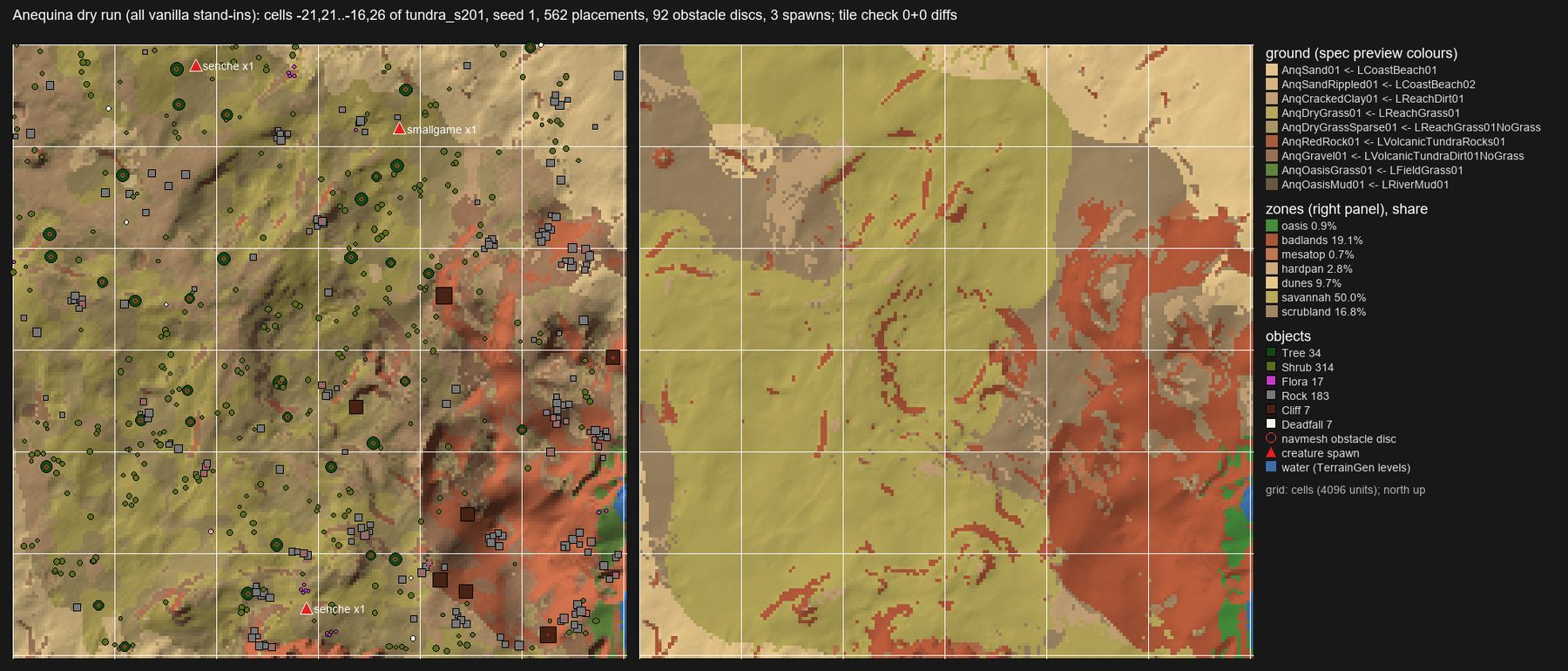
The pipeline can take biomes Skyrim doesn’t have, such as Elsweyr’s Anequina desert, once custom models are supplied.

Verification
Proof, not vibes.
Nothing is accepted on a model’s say-so. Every result is rebuilt from its commit and checked by machine, then judged by eye against vanilla.
Byte-level
Rebuilt and read back.
Plugins are written byte for byte, then read back independently with Mutagen. A reviewer rebuilds each result from a clean copy of its commit and compares hashes before anything is shown for approval.
Build gates
Checks that refuse a build.
No road over water without a bridge; no site or road bank steeper than vanilla’s; continuous rivers; matching seams between regions; dependency checks for actors and quests; cliff-top exposure; forest floor under its trees.
Creation Kit
A sandboxed editor.
An isolated Creation Kit with a custom C++ camera plug-in captures views tied to exact build hashes. xLODGen runs unattended so distant terrain matches the build just written.
In the game
An unattended test harness.
It boots the real game, walks NPCs along test routes, and restores the install file for file. Calibration session: 8 of 8 boots and restores verified. The generated region’s first in-game walk is planned this week.
How it’s built
One architect, a team of agents.
The project is developed by AI coding agents working under one set of project rules, with James setting direction and judging the pictures.
Lanes
Up to four agents at once.
An architect agent splits the work into lanes (terrain, biomes, sites and assembly, interiors, roads and plans, gameplay content, in-game testing). Each lane owns its files, commits only those, and hands its result back with pictures. The architect rebuilds and checks it before James sees it.
Decisions
Agreed with pictures.
Big changes go to James as a decision brief: options with example pictures and a recommended choice. His verdicts are recorded per round and become training data for the critic.
Rules
Official game files only.
Sources are Skyrim.esm, Update.esm and the three official DLC, in an explicit load order. No third-party mods, and the game install is never modified outside the test harness, which restores it.
Stack
Built with
| Pipeline stage | Module | State |
|---|---|---|
| Land and water | TerrainGen | Working |
| Biomes and wilderness fill | BiomeFill | Working |
| Site plan | SitePlan | Revising |
| Road network | RoadPlan | Revising |
| Sites: transplant and assembly | SiteTransplant | Working |
| Site variation | SiteVariation | In review |
| Navmesh | NavmeshGen | Working |
| Interiors and dungeons | InteriorTransplant, DungeonGen | Round 3 |
| Gameplay records and persistent content | GameplayLayer, PersistentContent | Working |
| Distant LOD | LodGen | Working |
| Checks and in-game tests | MutagenCheck, GameTest | Working |
FAQ
Skyrim Creation Kit MCP server questions.
What is the Skyrim Creation Kit MCP server?
The Skyrim Creation Kit MCP Server (repository creationkit-mcp) is a Model Context Protocol server with 80 tools, backed by a .NET build pipeline, that lets AI models build new Skyrim Special Edition worldspaces. An MCP client calls its tools to plan a world and write it as a plugin, and every result is read back with Mutagen and inspected in an isolated Creation Kit sandbox. It is an unaffiliated fan project by James Mann.
What can the Skyrim Creation Kit MCP server generate?
Terrain in eight scene types quilted from vanilla Skyrim landscape pieces; rivers, lakes and waterfalls; biomes with trees, rocks and ground cover placed from the shape of the land; transplanted and varied Bethesda sites such as Helgen, Riverwood and Fort Greymoor; site plans and road networks with vanilla bridges; caves and Nordic ruins built from Bethesda’s kit pieces; and navmesh, gameplay records and distant LOD for the finished region.
What do I need to run the Skyrim Creation Kit MCP server?
A Windows PC with Skyrim Special Edition’s official game files and Python. The README creates a Python virtual environment, installs requirements.txt, and runs mcp_server.py as a local stdio MCP server; an MCP host is configured to launch that environment’s Python with the absolute path to mcp_server.py. The independent Mutagen verifier needs the .NET SDK, the Creation Kit inspection tools need a copied Creation Kit sandbox with the CKPE camera plug-in, and the local-model scripts need a local Qwen model service.
Project log
Project log and source code.
Dated progress reports and the public creationkit-mcp repository.
Project log · October 29, 2026
Project log: October 29, 2026 — waterfalls, biomes and a desert scene.
One week in: the status of every part of the pipeline, the waterfall rework, biomes placed from the land, the new desert scene, the timeline since October 23, and the next steps.
Read the October 29 logFollow along
In active development.
The source is public on GitHub as creationkit-mcp, and its README is the tool and command reference. Updates go out on GitHub and X.